
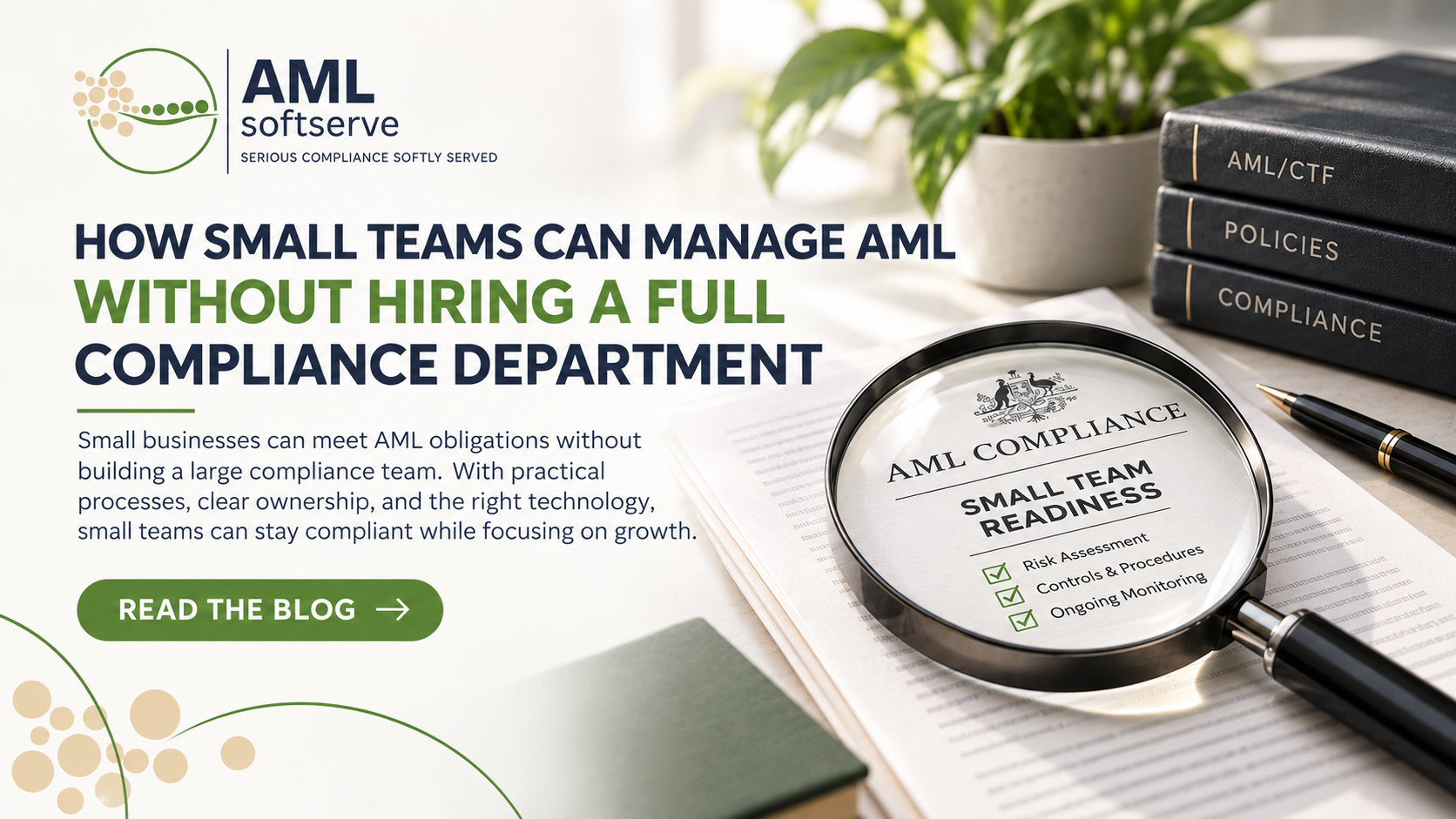
For many small businesses, compliance can feel like a task designed for companies with entire legal and risk departments.
Large organisations may have dedicated compliance officers, analysts, and teams monitoring customer activity every day.
But what about a growing business with only a handful of employees?
The reality is that many Australian businesses are expected to meet AML obligations without having the resources of a large corporation. Business owners often find themselves balancing daily operations, customer service, sales, and compliance responsibilities all at once.
The challenge is not understanding that AML matters.
The challenge is managing it efficiently without creating unnecessary costs or overwhelming existing staff.
The good news is that effective AML compliance does not always require a large department. With the right processes, clear responsibilities, and practical technology, small teams can build a strong AML framework that protects their business and supports growth.
Why AML Can Feel Overwhelming for Small Businesses
Small businesses often operate with limited time and resources.
A business owner may already be managing employees, finances, customers, and operations. Adding AML responsibilities into the mix can feel like another complicated obligation.
Common challenges include:
- Not having a dedicated compliance specialist
- Limited knowledge of AML requirements
- Manual customer checks taking too much time
- Difficulty monitoring ongoing customer activity
- Uncertainty about what needs to be documented
However, AML compliance does not need to become a burden.
The key is creating a system that works alongside the business rather than adding unnecessary complexity.
AML Compliance Is About Smart Processes, Not Bigger Teams
A common misconception is that effective AML compliance requires hiring more people.
While compliance professionals are valuable, many small businesses can manage their AML responsibilities by improving how they work.
Strong AML compliance usually comes down to three things:
- Understanding customer risk
- Following consistent processes
- Using the right tools to support decision-making
A smaller team with organised processes can often manage compliance more effectively than a larger team relying on outdated manual methods.
Build a Practical AML Framework for Your Business
Assign Clear AML Responsibilities
Even without a dedicated compliance department, someone within the business should be responsible for overseeing AML activities.
This does not mean one person must handle everything alone.
Instead, businesses should clearly define:
- Who reviews customer information
- Who approves higher-risk customers
- Who monitors unusual activity
- Who maintains compliance records
Clear ownership prevents important tasks from being forgotten.
Create Simple, Repeatable Procedures
AML processes should be easy for employees to follow.
A practical approach may include:
- Standard customer verification steps
- Risk assessment checklists
- Document storage procedures
- Review schedules
- Escalation processes for suspicious activity
The goal is consistency.
When processes depend only on memory or individual judgement, mistakes become more likely.
How Technology Helps Small Teams Manage AML
Technology has changed the way businesses approach compliance.
Small businesses no longer need to rely entirely on spreadsheets, manual searches, and time-consuming reviews.
Modern AML solutions can help automate many routine tasks, allowing small teams to manage compliance more efficiently.
Ongoing Customer Monitoring
Customer risk can change over time.
A customer who appeared low-risk during onboarding may later show unusual activity.
Ongoing AML monitoring helps businesses stay aware of changes by continuously reviewing relevant customer information and activity patterns.
Faster Risk Identification
Small teams cannot spend hours manually reviewing every transaction.
Technology can help highlight activity that requires attention, allowing employees to focus on meaningful reviews instead of repetitive checks.
Better Compliance Records
Keeping accurate records is a critical part of AML management.
Digital solutions can help businesses maintain organised records of customer reviews, risk assessments, and compliance actions.
This makes it easier to demonstrate that AML processes are active and effective.
The Cost of Ignoring AML Responsibilities
Some small businesses delay improving their AML processes because they believe compliance is something they can address later.
However, waiting can create unnecessary risks.
Weak AML practices may lead to:
- Regulatory concerns
- Financial penalties
- Disrupted operations
- Loss of customer trust
- Damage to business reputation
For a small business, reputation is one of its most valuable assets.
A single compliance issue can have a much larger impact when resources and customer relationships are limited.
How Small Businesses Can Improve AML Without Increasing Costs
Start With a Risk-Based Approach
Not every customer or transaction carries the same level of risk.
A risk-based AML approach allows businesses to focus their attention where it matters most.
Instead of treating every situation equally, businesses can apply stronger checks when risk indicators appear.
Train Employees Regularly
Employees do not need to become compliance experts, but they should understand their role.
Simple training can help teams recognise:
- Suspicious customer behaviour
- Unusual transaction patterns
- When concerns should be escalated
A knowledgeable team is one of the strongest AML tools a business can have.
Use Technology to Extend Your Team
For small businesses, technology can act as a compliance partner.
Instead of hiring additional employees to handle every manual task, businesses can use AML software to automate processes and improve efficiency.
The goal is not to replace people.
It is to help people make better decisions.
Why Outsourcing and AML Technology Are Becoming More Popular
Many small businesses are choosing smarter compliance solutions instead of building expensive internal departments.
This approach allows them to access professional-grade AML capabilities without the cost of maintaining a large compliance team.
With the right AML solution, businesses can benefit from:
- More efficient monitoring
- Improved accuracy
- Reduced administrative workload
- Stronger compliance visibility
This allows business owners to focus on running and growing their businesses while maintaining confidence in their compliance processes.
Small Team Does Not Mean Small Compliance Capability
A business does not need dozens of employees to manage AML effectively.
What matters is having the right approach.
Clear processes, regular reviews, employee awareness, and reliable AML technology can help small teams create a strong compliance environment.
The businesses that succeed are not always the ones with the biggest compliance departments.
They are the ones that recognise the importance of compliance and build systems that support their goals.
Simplify AML Compliance With AML SoftServe
Managing AML responsibilities with a small team can be challenging, but it does not have to slow your business down.
AML SoftServe helps Australian businesses streamline their AML compliance processes with practical solutions designed to support customer monitoring, risk management, and ongoing compliance needs.
Discover how your business can manage AML more efficiently without the cost and complexity of building a full compliance department.
Visit amlsoftserve.com.au today and take the next step toward smarter AML compliance.